Years of Lead by Miquel Vila
The divorce between the state and the nation-state is the crucial underlying political development taking place on the European continent. The national question, which is the question of the demos and the people, is no longer defined primarily by the struggle to create new states or defend the sovereignty of existing ones. It increasingly concerns the separation between historic nations and the states that once claimed to represent them.
As Western states become more bureaucratic, multicultural and post-national, native populations increasingly perceive political institutions as external powers managing their decline rather than instruments of their collective will. The emerging political divide is therefore between the native and the foreign: between those who understand the state as possessing obligations toward a particular historic people and those who regard it as the neutral administrator of interchangeable populations.
The word "foreign" here does not refer exclusively to citizenship or place of birth. It describes a political relationship to the historic nation. A person born abroad may submit to the existing state regime, while a national born within its borders may regard the current regime as an obstacle to be overcome for the sake of national continuity. The dividing line concerns whether the inherited population possesses a special claim over the institutions, territory and future of the country they built.
As Schmitt wrote in The Concept of the Political, "The protego ergo obligo is the cogito ergo sum of the state." The forgotten question underneath "who decides?" is "who protects?" Political obedience historically rested upon a relationship between protection and obligation. Once significant parts of the historic population cease to believe that the state regards their continuity as something to protect, the democratic question of who controls government becomes secondary to the deeper question of whom government exists for.
The European Managerial State
We often hear that liberal managerialism is just an American import in Europe. That's not true. Since the end of World War 2, Europeans have been co-creators, often providing the ideological muscle to the international liberal structure. There is a stream of homegrown liberal managerialism with European characteristics that is firmly shared by the ruling political class across the European Union and beyond. Its European form has therefore not meant the retreat of the state, but a transformation of its purposes and of the way its power is exercised.
The separation of state and nation should not be confused with the disappearance of state power. The anti-neoliberal critique that emerged during the 1990s argued that globalization, privatization and free-market deregulation had hollowed out state capacity. The developments of recent years, especially the reaction of European states during the COVID-19 pandemic or the recent crackdowns on the private use of air conditioning across Europe, demonstrate how incomplete that interpretation is.
It's true that there is an evident erosion of state efficiency across European countries reflected in infrastructures, administration and legislation quality, and even security, but that loss of state capacity is uneven, if not directly selective. When governments decide to act, they act. They can close businesses, restrict movements, reorganize education and media, suspend ordinary liberties and impose new rules on the most intimate parts of social life. That's what online discourse has popularized as anarcho-tyranny.
But the loss of efficiency of the state might also be related to the size of the (post)modern or managerial state. The state has become less efficient in nearly all areas that initially created its legitimacy for the nation: public services, public infrastructure, rule of law, security and control over borders and migration. Now, however, the state primarily expands when it comes to managing different people within the nation and imposing a social consensus. The contemporary state reaches almost everywhere: it educates children, licenses professions, distributes income, regulates housing and the internet, supervises employment, funds media and determines which associations qualify for public support.
The paradox of the managerial state is that even where public services deteriorate, the administrative presence of the state continues to expand. A government can monitor the language used in a workplace while failing to keep public transport safe and functioning. Failure rarely causes the apparatus to withdraw, but rather leads to the incorporation of a new committee, procedure, agency, reporting requirement or layer of professional management.
The new logic has changed the stated purpose of government, with members of the historic nation becoming an object to be administered alongside other demographic and social categories. Its traditions are translated into heritage programs. The nation may continue to be invoked in public ceremonies while losing its privileged position in decisions about the composition and preservation of its own body as a source of legitimacy.
That has provoked a process that the British military strategist David Betz, drawing on Barbara Walter's work on civil conflict, calls "downgrading." The term describes the perception that a formerly dominant population is experiencing a status reversal. What used to be the official culture of the state becomes just one option among others, if not directly a tradition to be deconstructed and denounced: its inherited symbols become controversial and its territorial dominance is reinterpreted as an unfair privilege. The thought that newcomers should assimilate into the national body disappears through the demand that public institutions must adapt themselves to multiple cultural communities.
The sense of downgrading grows when the state displays greater confidence in disciplining the native population than in imposing common rules on organized minorities. Public authorities may consider the former sufficiently disciplined to absorb restrictions, criticism and neglect without threatening social peace. Communities perceived as volatile or vulnerable receive more careful treatment. In this sense, the rationality of managerial governance rewards those capable of generating disruption.
This asymmetry does not require an explicit policy against the historic nation. It can emerge from thousands of individual administrative decisions that may even appear reasonable in isolation but, together, communicate that some populations must adapt while others are to be accommodated.
The political importance of this process lies in the continued size and organization of the population experiencing it. The historic nation has not disappeared and, despite certain narratives, may still not be a minority in its own country. It retains memories, territorial concentrations and inherited institutions. The historic nation therefore begins to see itself as one community competing with others inside a state that no longer belongs to it.
The Allure of Civil War
That change in the form of governance touches the key element that legitimate modern democratic liberal nation states. States before the emergence of modern mass nationalism, even if they already had strong identifiable ethnic identities, were legitimized upon loyalty to the sovereign and monarch, to the owner of the Crown who had proprietorship over the state. Modern democracies cannot rely on that form of legitimacy. They require some conception of a political people in whose name authority is exercised.
Habermassian Constitutionalist patriotism is clearly only a justification for those who already have a stake in the state, not for those who are just its subjects. That erosion of legitimacy opens the conditions of possibility for a growing multilevel and multisided conflict: within native European populations themselves, between those populations and foreign communities experienced as competitors, and between both and a divided state apparatus.
Of course, the downgrading is not experienced in the same way by all the members of the native European nations, as many members, or even arguably a majority, of the historic nation can accept or even embrace the ideological narratives of guilt and the post-national project. That makes the scenario of civil war not only an inter-ethnic conflict but also an ideological conflict within the historic nation, which might actually be the most important conflict, as it is members of the historic nation and the governing class who have empowered the other groups to start with.
Betz has talked extensively about the idea of civil war coming to Britain and, by extension, the West, and although he is not the first to insinuate this, he is the one who has arguably presented the most compelling argument. Nevertheless, the resolutive scenario of civil war might be a comfortable nightmare.
The scenario of civil war promises that, after years of political systems in permanent crisis, there is an end to worthless words, institutional paralysis and managed decline. We can fantasize about a moment of reckoning that promises to resolve every contradiction at once. The winners will finally win; the losers will lose for real. Recent history, however, offers a much less categorical resolution.
Western Europe has not experienced a full-on civil war since the Second World War. Nevertheless, it has experienced prolonged forms of low-intensity civil strife that combined elements of war with normal and boring politics. There was, however, another reality inhabited by particular neighborhoods, families and political militants in what is known as the Years of Lead, or, in its Italian original, Anni di Piombo.
This period began in the years of the counterculture of the late 1960s and continued well into the 1980s. Key episodes of violence were the Piazza Fontana bombing, the Red Brigades' kidnapping and murder of former prime minister Aldo Moro, and the Bologna railway-station massacre. Revolutionary leftists and neofascists killed, kidnapped and bombed without coming close to achieving control of the country.
This was, however, not only an Italian phenomenon but was also present in other parts of Europe. In the Basque Country, the armed separatist organization ETA waged a decades-long campaign, even after Spain's transition, with hundreds of casualties before its final ceasefire and dissolution. The conflict produced its own prisoners, political organizations, social rituals and cycles of state overreach, like the GAL-linked death squads in the 1980s. Similarly, Northern Ireland developed the most structured conflict, organized around a symmetrical division of communities between Catholics and Protestants. The Troubles killed roughly 3,500 people over three decades, with Republican and loyalist paramilitaries operating alongside British security forces, while Britain and the Republic of Ireland maintained complicated relationships with the populations claiming their allegiance.
Despite their meaningful differences, what these examples have in common is that, rather than producing an epic Ragnarok, they instead brought years of assassinations, reprisals, criminality and ambiguous state violence. Most of these conflicts ended with a combination of state repression, desertion and, finally, political exhaustion. The truth is that when meaningful events in the conflict occurred, they marked the day-to-day life of the nations, but apart from the minority of active militants involved and the random collateral damage, the great majority of citizens carried on with their ordinary lives, people still had to keep going to work every day, elections continued to be held and the state did not collapse.
The new political divides
If we are to imagine a plausible near- to medium-term scenario of internal confrontation in Europe, these conflicts offer a more convincing model of future fragmentation than total civil war. None overthrew the state; each created a prolonged conflict over territory, institutions, policing and political legitimacy. On the contrary, the end result was an expansion of the managerial state, through welfarist arrangements and the expansion of policing capacity, that would ultimately bring further discipline. The Gramscian war of position became more real than metaphorical, while the decisive moment continually receded.
Recent confrontations around immigration show not only how quickly individual crimes can acquire a communal meaning, but also how European populations seem to be more willing to take justice into their own hands, even if still in the form of disorganized social eruptions.
A series of gruesome events, like the stabbing of three children and a care worker outside a school in Dublin in November 2023, triggered hours of anti-immigration riots. Less than a year later, the murder of three young girls at a dance class in Southport produced an even broader reaction across England. The same dynamic appeared in Torre Pacheco, in the Spanish region of Murcia, during July 2025. The assault of an elderly resident, for which three North African men were eventually arrested, was followed by several nights of confrontations involving local residents, right-wing nationalists, migrants and riot police.
These episodes do not demonstrate the imminence of civil war but rather a political environment in which the perception of abandonment by the state among native European populations is propelling a scenario of civil unrest, marked by a complex conflict between the native, the foreign and the state.
It is in the peripheries of Western Europe that we can see how this new political alignment is playing out with more acute contradictions. How this dynamic unfolds in territories traversed by secessionist conflicts is interesting because the distinction between native and foreign is superimposed upon an older dispute over national sovereignty. In each territory, rival national movements already disagree about who constitutes the historic political community. Irish nationalists and Unionists offer incompatible accounts of Northern Ireland's national identity, in the same way that Catalan separatists and Spanish unionists do. For decades, these divisions have structured almost every important political question. Nonetheless, the issue of immigration introduces another frontier that does not erase the old conflict but changes the relationship between its participants.
Across different anti-immigration-related events in Belfast, Irish tricolours have appeared alongside Union Jacks. The first of these was reported in August 2024, when activists from the Republic joined loyalists in a protest that later descended into attacks on migrant-owned businesses. This could still be dismissed as an outlier event; however, in June 2026 we saw something that may point towards a more real tectonic shift. After a Sudanese migrant attempted to behead a man in a strongly Catholic-nationalist part of North Belfast, riots were concentrated largely in loyalist areas. However, as Aris Roussinos narrated, there was a significant change in attitude among Catholics, with people in traditional republican areas watching the loyalist response with a degree of sympathy that would previously have been almost unimaginable. Roussinos reports that in Ardoyne, one of Belfast's most historically volatile sectarian choke points, protesters from the two communities even shook hands. Roussinos cautiously described what he witnessed as the "first glimmerings of a tentative and distrustful rapprochement," which nevertheless could quickly be swallowed by the ancient sectarian divide.
Catalonia displays a similar process, without Northern Ireland's history of sectarian war but following the high tensions of the independence attempt of 2017. Catalan and Spanish nationalist forces continue to disagree about the sovereign identity of Catalonia, yet increasingly interpret local conflicts through a common opposition between the native population and extra-European immigration. The rise of Sílvia Orriols' Aliança Catalana, a right-wing party that has put opposition to mass migration at the forefront of Catalan nationalism, illustrates this shift in a movement otherwise usually characterized by a strong left-liberal leaning.
At the same time in Spain, the divorce between state and nation also appears in competing attempts to redefine Spanish identity. The official model oscillates between progressive multiculturalism and a conservative reconstruction through the idea of Hispanidad – for example, Vox has increasingly framed Spain less as an exclusively European nation formed by a Castilian core that incorporates regional identities and more as the political and cultural center of a broader Hispanic community that can absorb Latin American immigration. This has generated unease among younger right-wing Spaniards who see both models as diluting their identity as native Europeans.
The divorce between the state and the nation in Spain has reached a dramatic point after the illegal border crossing of more than 70,000 people from Morocco to Ceuta, the Spanish city in North Africa reclaimed by Rabat. Weeks after the crossing, security in the city rapidly deteriorated, with almost one sexual assault a day, according to the city's chief prosecutor, Silvia Rojas, who stated that there was growing concern. This has been a difficult crisis for the openly pro-immigration government of Pedro Sánchez, and the citizens of Ceuta have felt abandoned by Madrid. The locals have decided to take matters into their own hands, blocking Red Cross volunteers from distributing food to the migrants encamped around the city, while another group descended on a migrant camp, dismantling and burning part of it before riot police intervened against the Ceutis. With the government having to reassert control over its external border while also bringing Ceuta's native population back under discipline, tensions have escalated into a crisis of confidence in the Spanish state itself.
These examples, rather than being just fringe curiosities, show how strongly the new articulation of the native-foreign frontier is capable of cutting across the old distinction between separatists and unionists. What has changed is the hierarchy of differences. For sections of historically opposed communities, the traditional enemy increasingly appears as another historically rooted European population with whom they share a territory, while extra-European immigration introduces a population standing outside both versions of the old national dispute.
In that narrow sense, the shared "indigenous Europeanness" creates limited convergence among movements that remain opposed on sovereignty because both encounter a state that has become detached from their respective understandings of the nation.
Fragmentation Without Collapse
One could argue that a scenario in which things become dangerously worse, perhaps even reaching a point of no return, while the system nevertheless refuses to break entirely is itself a comfortable fantasy. That is a fair objection, and scenarios in every direction should be explored. Yet fragmentation without collapse still appears the more plausible near- to medium-term outcome, given both the current nature of the European managerial state and dynamics already unfolding across the continent. The state is simply too large and too deeply embedded in society to collapse.
The state is simultaneously an autonomous institution with its own bureaucratic rationality, a tool used by governments to enforce their programs, and a battleground traversed by factional divisions. Ministers issue orders, yet permanent officials interpret them. Courts redefine their legal limits. Local authorities adapt national policies to local circumstances. Police commanders, teachers, social workers and publicly funded organizations exercise discretion at the point of implementation.
Different sections of this apparatus may consequently serve different conceptions of the political community. One department may retain a strong attachment to national continuity. Another may be guided by universalist law, professional ideology or the demands of organized minority groups. Municipal officials may prioritize social peace over uniform law enforcement. Police forces may tolerate behavior from one community that they would confront in another because they anticipate different risks or hold different loyalties.
Britain's debate over "two-tier policing" captures this anxiety. Many citizens believe that the law is applied through informal calculations about political sensitivity, communal reaction and the identity of the people involved. The history of the grooming-gang scandals provides a more concrete example of bureaucratic behavior changing under these pressures. The official inquiry into Rotherham found that staff were nervous about identifying the ethnic origins of perpetrators for fear of being considered racist, while others remembered managers directing them not to do so. A later government inspection described officials as unwilling to confront difficult issues because they feared accusations of racism or damage to community cohesion.
No secret central command was necessary as the system had created professional incentives, ideological assumptions and fears of controversy that were enough to produce an informal differentiation in enforcement. This is how a fragmented managerial state operates. While it maintains a common legal framework, different parts of the bureaucracy interpret their responsibilities through different political and moral priorities.
The result will rarely be a clean separation between state and nation, and European politics will operate in a sea of greys. There will be territories where public institutions remain closely identified with the historic population, while other regions, cities and neighborhoods will experience a wider gap between the formal authority of the state and the communities actually shaping their social reality.
Geographical fragmentation may become visible through patterns of settlement and local political control. A municipal government can adopt policies very different from those of the national administration operating within the same territory. Police may retain formal access to every neighborhood while relying on community intermediaries and informal negotiation in practice.
The managerial state is also fragmented internally because it reaches so deeply into all aspects of society. A limited state can retreat from territory or abandon a specific function, but the contemporary Western state has built institutions around nearly every field of social activity. When a common national purpose disappears, those institutions remain in place and begin to pursue their own professional interests and ideological commitments and to protect their own members, clients and networks. One section of the bureaucracy may enforce strict immigration rules, another multiculturalism. A police force may contain officers who identify strongly with the historic nation, commanders focused on managing intercommunal conflict, and internal factions tied to specific extra-European communities. Their actions may contradict one another without producing a formal collapse of the state.
The same fragmentation extends beyond the legal boundaries of government. Publicly financed charities, contractors, universities, media organizations and professional bodies participate in the implementation of state policy, forming a managerial ecosystem through which authority is exercised without always appearing as direct coercion. The distinction between state and civil society has become blurred, while the distinction between the nation and this institutional system has become sharper.
In strategic terms, this structure explains why capturing the national government rarely produces the cultural transformation promised by national-populist parties. They may appoint ministers, change legislation and redirect some funding, but then encounter courts, public servants, unions, local governments and publicly supported organizations able to delay, reinterpret or resist their program. Electoral victories remain a real gain, of course, but they do not automatically translate into effective state power without the organized muscle capable of contesting the political battle beyond elections and in the streets. Given the current size of the managerial state, the idea of building parallel states is unrealistic. Yet faith in the state alone as the principal creator of national renewal also threatens Europe's historic communities.
Europe is moving toward an order in which the state remains large, and omnipresent while becoming less capable of speaking with a single voice that represents their original European nation. Authority will fragment laterally across geographies and vertically across bureaucracies and through the informal practices by which laws are interpreted and enforced. Some parts of the state will continue to serve the historic nation while others will administer it as one population among many, if not as a hostile group requiring constant discipline. The political movements that endure will be those able to operate within this ambiguity. They will use the state where possible, resist it where necessary and build beyond it wherever dependence threatens national survival. Periods in government will have to be used to restrict opponents' access to public resources and weaken the networks that sustain them, while preserving autonomous sources of power, organization and wealth on their own side. Movements that combine temporary control of the state with durable power outside it will be better equipped to survive and compete in a fragmented political order. Sovereignty will remain an important goal, but its value will ultimately depend upon whether a living nation still exists beneath the state form.
Miquel Vila is a strategy consultant and analyst focused on critical infrastructure, global supply chains, technology, and geopolitics. He can be followed on X at @miquelvilam.
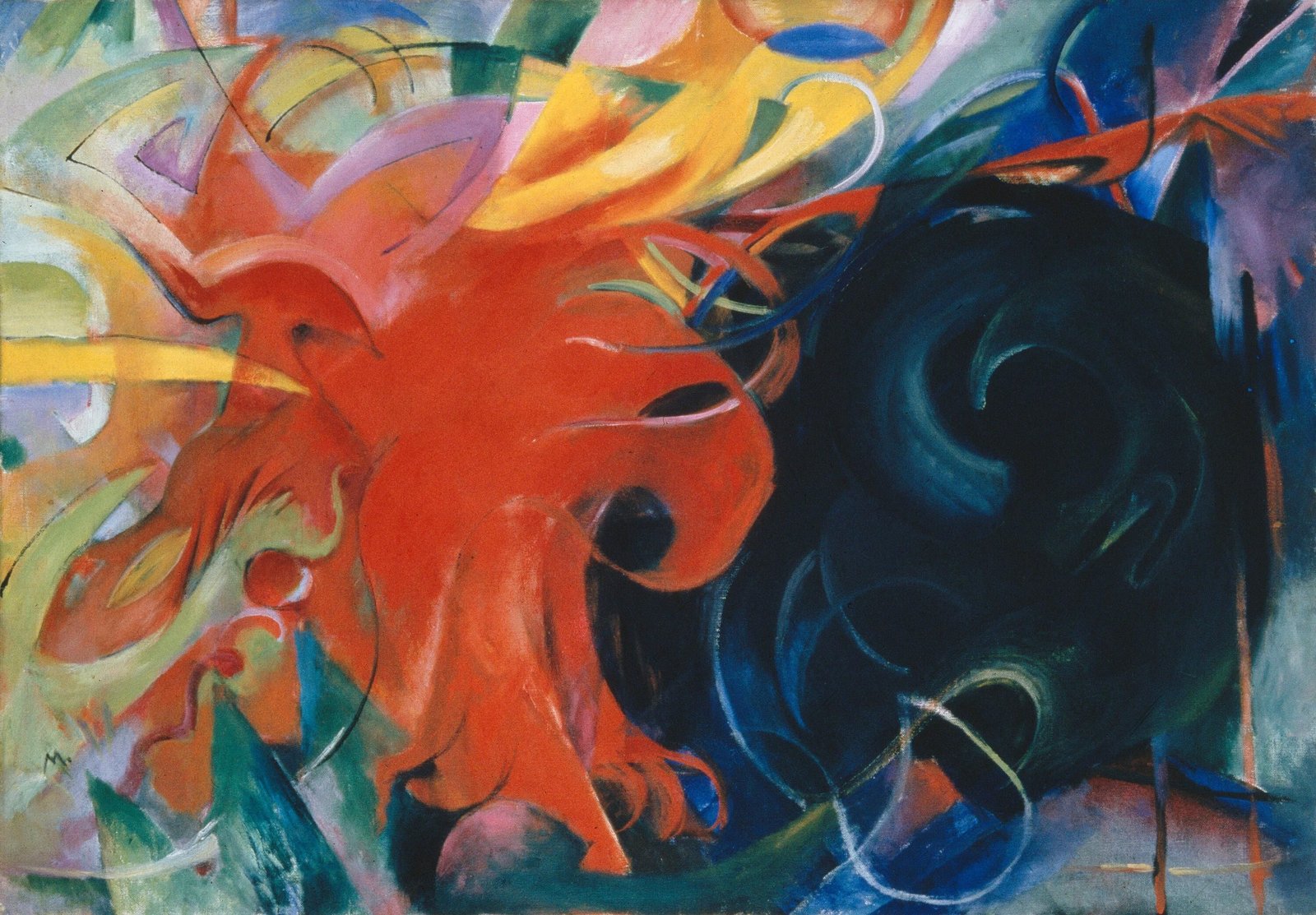
Cover image: Franz Marc, Kämpfende Formen (Fighting Forms), 1914. Bayerische Staatsgemäldesammlungen, Pinakothek der Moderne, Munich. CC BY-SA 4.0.