Crvena, Plava, Bela with Ognjen Gocij
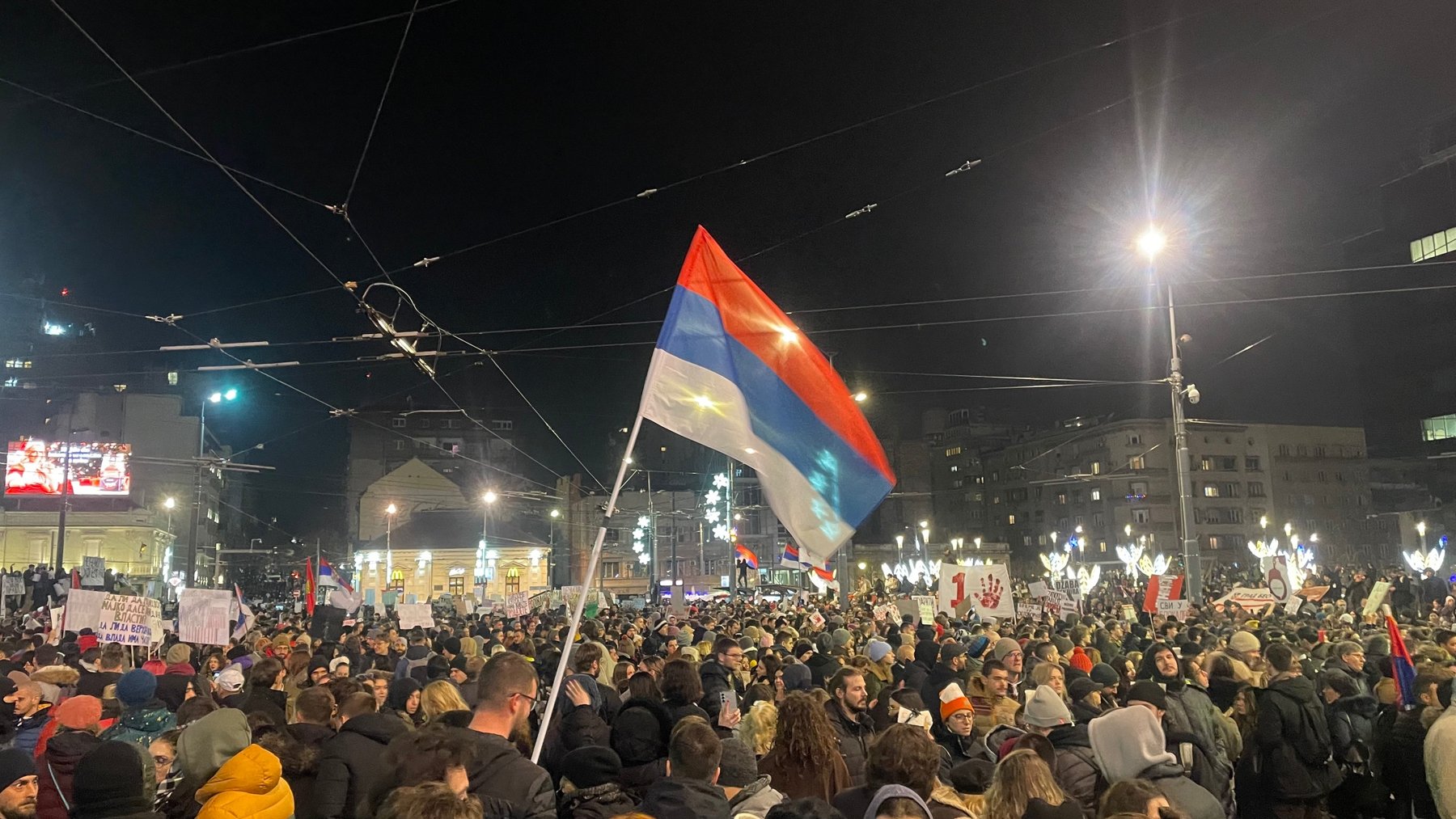
On 1 November 2024, a canopy at the railway station in Novi Sad, Serbia’s second-largest city, collapsed, killing 16 people. It prompted an immediate reaction from students across the country, who demanded accountability and blamed the government’s corruption and negligence. What started as a protest turned, over the following months and years, into a nationwide political movement that has already significantly changed Serbian society and has the potential to fundamentally transform Serbian politics.
We are just hours away from the results, and I had the chance to speak to Ognjen Gocij, a political consultant and analyst in Serbia who has been following the Vučić regime and the student protests from the start.
Interregnum: The first question that struck me looking at the student protests in Serbia is how they are so successful potentially ending the Vučić regime?
Ognjen: We actually no longer call them protests. Protests are traditionally more against something, whether that is the government, corruption, or a specific policy. The students have now formed a political movement with the goal of taking over the state. That’s also partly the reason why the students are as successful as they are. Rather than supporting an opposition party, they decided independently to create their own political movement.
Interregnum: Was there a decisive moment when the students realized how much support they had, and when the movement turned from protest to "we need to take over the political system"?
Ognjen: It was a cumulative process. From early February to mid-March, every second Saturday, they organized large gatherings in the biggest cities in Serbia. The turnout exceeded their own expectations and that's when they realized: we have a huge asset on our side.
The official story is that it happened in May last year. They had said they would keep blocking the faculties until their demands were met, first four demands, later expanded to six. Then they said: this government will not meet our demands, so we will enter politics ourselves to meet them. However, already in March they knew they had enormous support and had to do something with it.
Interregnum: These aren't the first mass protests in modern Serbian history. There were the 1996–97 protests over the local elections against Milošević, and more recently the protests against the lithium project in 2024. What's different now?
Ognjen: Throughout the 1990s, in 1992, in 1996–97, and again in 2000 after the elections, the protests were always in support of the opposition. Protesters never had the ambition to take responsibility themselves. This time, already in February and March, the students distanced themselves from the opposition: we have nothing to do with you, we don't cooperate with you. Eventually they said: we want to take responsibility, and we expect you to support us. For the first time the students are political actors in their own right.
Interregnum: How do they organize themselves without leaders? How do they decide on demands, or on who goes on the electoral list?
Ognjen: The faculties have formal structures like the student parliament, with elected representatives. The real decisions though are made in the plenums. Everybody is invited, and whoever shows up decides. It's a direct democracy. Common decisions require consensus among the plenums of all the faculties. For the electoral list, they voted on individual candidates and each candidate needed a majority of votes. In short, there was never a leadership or formalized political party structure.
Interregnum: In the 2000s the US and the EU were heavily involved in the Balkans. Yet Western coverage of these protests has been strikingly thin, and there are no EU flags at the protests, unlike in Georgia or elsewhere. Is the EU seen as the kiss of death for the students? Is it understood that Vučić is really the EU's man, despite being portrayed in the West as pro-Russian?
Ognjen: Flags of other nations were actually forbidden. The rules of the protest allowed only the Serbian flag. When people brought, say, a Palestinian flag, they were told no flags or symbols of that kind. However, even without the rule, nobody would carry an EU flag and there are three reasons for this.
First, people are fed up with the EU story. It's been going on for decades, and nobody believes it any longer. It feels old and repetitive, like recycling a story people have lost hope in.
Second, Vučić always accused the students of being a color revolution. He's careful about how he puts it, but he implies that they're backed by foreign powers and secret services, that the West wants to destroy Serbia with help from domestic traitors. If protesters displayed EU flags, he and his media would say: look, they're doing what was done in Ukraine and Georgia. Additionally, that story makes no sense, because he is the one promising to take Serbia into the EU.
Third, he managed to establish a close relationship with the EU, Germany above all, and everybody here knows it. The EU also didn't endorse or support the protests. It only began to show some understanding when things really got out of hand with the hooligans and attacks on the students. So the attitude became: you need to earn your place, and your flag.
Interregnum: Serbia is arguably the most important country in the region. Consequently, foreign powers will try to influence a student-led government. How will the students handle that pressure, for example on Kosovo?
Ognjen: It's too early to tell, but a few things can be said. In 2000, the overthrow of Milošević was heavily supported by the West, and the new democratic government owed it a lot. This time there's nothing like that. It's grassroots, bottom-up, and there's no debt to the West. They don't owe anything to anybody. If someone wants to apply pressure, good luck with that. I think the EU will need to accommodate them in the end.
Also, Vučić was compliant in his early years, but later he started creating crises in Bosnia, in Croatia, in Montenegro for his own political gain. The students won't stir up trouble in the region for the sake of it. That is very meaningful and it should be appreciated.
On Kosovo, they consider it part of Serbia, and they criticized Vučić for conceding too much. For example, he dismantled the political structures Serbs had there.
Vučić always built the image of a national hero, a patriot, while compromising, doing one thing and saying another. Even if the students make concessions on Kosovo, they won't be perceived as betraying patriotism. People will believe they're actually protecting the national interest.
Interregnum: Will they win tomorrow, and will the election go smoothly? Vučić has built a network of power in the media, the church, and the economy and it is difficult to imagine that he will easily give up power.
Ognjen: Maybe it is wishful thinking but I believe that the students' margin will be so large that it will be impossible to question the result. I would not be surprised if they simply declared victory and took over, without letting him drag them into some protracted process where he could manipulate things.
There are several scenarios, and none of them is really in his hands. He might see the turnout on election day and accept it. If he tries something, people will go out into the streets the same day.
I also see signs that he received a call from foreign powers. It’s an intuition based on some indicators and Vučić’s behavior in the past weeks. I don't think he ever wanted these elections. I think he was compelled to call them. In the past, when students organized large gatherings, the old Vučić would halt public transport and the railways, and send people driving into crowds. Additionally, there was always a special TV program about an attempted coup. None of that happened this time. He is no longer behaving like he used to just weeks ago.
Interregnum: So the West read the room? Vučić did what he was supposed to do, the lithium deal and so on, and now his time is up?
Ognjen: I actually think the West gave him up because he is no longer delivering. The protests showed his limits: he couldn't curb them. On top of that the Rio Tinto lithium project that was supposed to deliver lithium for the German car industry has been halted. He also didn't kick Russian assets out, which I think both the Americans and the Europeans expected. On the contrary, he let Russia maneuver in Serbia at will. They use Serbia as a platform, an incubator for hybrid warfare in Europe.
For instance, a network was dismantled that ran a training camp for paramilitary units meant to create chaos in Moldova and Romania. There were provocations in Western Europe: pig heads left at mosques and antisemitic incidents. In May or June this year, a flight was being prepared to send a group of hooligans to Montenegro during the EU–Western Balkans summit. They were supposed to cause trouble there, and it was stopped.
Interregnum: I want to focus on the Serbian economy: the cost-of-living crisis, the second China shock, and the AI-shock. Would these protests have been as successful if young people were economically better off?
Ognjen: On a subconscious level, the economy is a crucial driving force. Polls always ask whether the country is going in the right direction and whether people are happy with the living conditions. Over the past year or two, the numbers started showing that people are no longer satisfied overall. It isn't articulated the way it is in France, where it's all about affordability. That being said, if people were happy with their living conditions, it would have been more difficult to mobilize them. Even some people turning against Vučić are struggling with rising costs and inflation, which is galloping in Serbia. They're anxious, but they can't quite put their finger on it. Still, even if things were better economically, the very fact that he started endangering children and students crossed a line.
In my opinion, the students wasted some potential there. They should have pointed out the economic and social inequalities. The middle class is against Vučić, while the impoverished support him. They failed to point out how well-off everyone in the regime is. That could have been used more, but they never made it a class issue.
Interregnum: Youth-led protests are happening everywhere, from France to Albania but also worldwide in Nepal and India. The pattern we see in France is that the police crack it down then something gets burned down in return, and then the protest is over. Thus, the question I have is what can other youth movements learn from the Serbian students?
Ognjen: Serbia's student movement is more democratic than others and it hasn't turned to violence, not even on the fringes. You can't equate whole movements with violent incidents, but there was violence in Albania, Italy, and France. In Serbia it only happened when the other side provoked it. It was pacifist from the start.
At the huge protests last year, there were so many people that if they had wanted to overthrow the government, nobody could have stopped them. They did not do it because it was never their intention as it wouldn't have been a legitimate transfer of power.
The difference with Italy or France, though maybe not Albania, is that Serbia is a captured state. One clique has captured it; the ruling party is essentially its political wing. In France you can bring change through elections. In Serbia the fight was about accountability, corruption and state capture. In a captured state you'd have more justification to take power by force, because elections aren't free and fair. All the opposition parties were in some way controlled by the regime, so the students had to become a political movement themselves to be successful.
Interregnum: Three years from now, what does Serbian politics look like? Is Vučić in prison? In Moscow?
Ognjen: I don't see any option for him except a plea deal, for him and his family. His gang members will probably look for refuge somewhere. I'm not sure he can even go to Moscow. Putin isn't pleased with his behavior, and someone can easily slip on a banana peel there. In short, he can't be protected there and it is unlikely that China is going to engage in that kind of business.
If you are not watching Serbian state TV you also cannot see how he's constantly provoking people inside and outside of the country. He's on TV around the clock, talking and talking, insulting one person after another. I doubt there has ever been a politician like that in Europe.
For tomorrow, maybe I'm too optimistic, but I think the students will win by a large margin and it will be done. Even if there's some short-term turbulence, if he refuses to concede, people will go out into the streets and get it done. Presidential elections are coming too. In the interim, his system will be dismantled, though some parts will resist. I'm concerned about someone from his entourage going crazy and provoking something that forces an emergency, whether Vučić likes it or not. That's the risk: rogue elements of the elite acting on their own.
In the mid to long term, this generation is something new and unique in Serbian culture, politics and society. They have a very different worldview. They're driven by their values: democratic, progressive, in short, enlightened. I think they'll make a profound change and finally turn Serbia into an open, European society.
Interregnum: Is that because they didn't experience the wars and the Milošević years?
Ognjen: There's a legacy of war, but it's more about upbringing. Older generations were raised to revere authority, the state, someone who cannot be questioned. People see Vučić as the boss. These kids weren't raised to fear and respect authority at the same time. They can't wrap their heads around the idea that someone is in charge and you're his servant, as most people here still think. That's the most profound change: how they understand authority.
I thought my own generation would be the one, but we had to wait for another. They're 21st-century people, and Vučić is a relic of the 19th century. Unfortunately, plenty of people in Serbia still expect a strongman at the head of state.
Interregnum: Is that why pensioners are his base? They're also the easiest to control, through pension increases.
Ognjen: Yes. They're told he's the one providing for them, so they feel dependent on him. And in their worldview you revere and obey the head of state and don't question him; what he says is true. This generation was brought up differently. Bowing to the sultan makes no sense to them. So there's a generational shift, a rupture. They understand the state as something that is supposed to serve us, not the other way around.
What I still can't understand is the strategy of going after students, of persecuting children. Protecting your offspring is a basic human instinct. He went against human nature.
Interregnum: I understand that because he's a skilled manipulator, and he's been in power a long time. He should have known better.
Ognjen: True, the emperor has no clothes. It wasn't really thought through. Vučić and his entourage thought that if they harassed and intimidated a bunch of kids on the street, they would back down and it would be over. Instead, they added fuel to the fire.
Interregnum: Once you can't crush a movement at the start, attacking it turns it political. You've declared war on part of your own society. Then you either crack down hard or you negotiate. Did he try negotiating?
Ognjen: He tried. He increased funding for universities to meet one of their demands, but it was a smokescreen, too little, too late. And the main demand was accountability for the canopy collapse. He couldn't deliver that, because his own government was responsible. So he tried to crush the movement instead, and it backfired. Most importantly, what Vučić got wrong and why he is done is because he went against human nature by attacking the children and students, those who need protection the most. When he started attacking the students with hooligans, party members, and essentially declared them enemies of the state, Serbian society started mobilizing as a whole against him. That decision was his end and will hopefully mark the beginning of an open and European Serbia.