American Warlords: The Potential for a New Renaissance by Johannes Mogk
1. The End of the Monopoly
One of the crucial events of our time happened in September 2022, in Ukraine. That month Ukrainian forces prepared a drone strike on the Russian Black Sea Fleet in Sevastopol. The success of this operation depended on Starlink, Elon Musk’s satellite network which Ukraine’s military relied on for nearly all of their battlefield communication. Kyiv asked for coverage to be extended to the waters off Crimea, crucially the request was not decided by Ukraine’s government, by the Pentagon, or by any NATO body. Instead, it was decided by a private individual, who declined.1 Consequently, the attack did not happen.
Countless articles, interviews, books, and documentaries have been done about the war between Russia and Ukraine and rightly so. It will be a defining war of our century. However, the owl of Minerva only sets at dusk – wisdom comes in hindsight and many of the impacts we simply cannot foresee as we are still in the middle of it. One conclusion that all observers of this war share left, right, center, Russian, and Ukrainian is that this war ushered in a new age of warfare. My point is that it will also usher in a new era domestically. This moment in September 2022 was so significant because a private actor set the limits of a sovereign state’s use of force in a war for its very survival.
For four centuries, the defining feature of the modern state has been what Max Weber called its monopoly on the legitimate use of physical violence. This monopoly of violence going back to the peace of Westphalia in 1648 is no longer intact as the means of war, such as satellite communications, launch capacity, battlefield software, and autonomous drones, are not owned by states but rented or sold from a small number of companies and the men who control them. In short, Ukraine might own drones but without Starlink, they are worthless.
The crisis of the Westphalian system and norms is also a crisis of Liberalism which has entered a phase of hyper-normalization, where the widespread recognition of systemic failure is coupled with an inability to envision viable alternatives. Liberalism, for all its suspicion of state power, has always depended on the state’s monopoly of force. The freedoms it promises, to trade, to speak, to pursue one’s own interest, presuppose a state strong enough to guarantee security inside its borders and against enemies outside them. Liberalism has spent two centuries dissolving the older loyalties of church, guild, and community, placing the individual in a direct relationship with markets and the state. Now the market is coming for the one foundational function Liberalism reserved for the state: security. Privatizing the monopoly of violence internally as externally marks the end of the liberal order more decisively than any election result.
The historical precedent for our time is fourteenth-century Italy, where the civil war between the Italian city-states and its feudal order collapsed into a market for violence and warfare. Mercenary companies from all over Europe led by condottieri sold their services to whichever city could pay, switched sides when the money changed, and ensured to prolong the wars that secured their employment. Their allegiances were transactional and revocable and that’s exactly why Machiavelli despised them. Alas, out of that market of violence and privatized security came something new. A century later after the first private companies, Francesco Sforza, in 1450, a mercenary captain and the son of one, made his defense of Milan conditional on being named its duke. The local aristocrats agreed and he became the rightful leader of the city, not only starting a new dynasty but also laying seeds for the modern state.
Today’s equivalent of the condottieri is the class of technology founders on whose companies the American state power depends: Musk’s SpaceX, Starlink, X, Peter Thiel and Alex Karp’s Palantir, Palmer Luckey’s Anduril to name only the most famous ones. Naturally, the world has changed in the past 500 years and whereas Sforza needed men to fight and die for him – necessitating at least some form of loyalty, drones and artificial intelligence completely break that link between violence and loyalty. In short, the Italian Condottieri of the Renaissance needed men. The American Condottieri of the 21st century need capital.
What comes after Liberalism is a market for protection, one in which security, like everything else, is bought, sold, and opted out of. For now, that market is external: states buy services of satellite networks, targeting software, and drones from private companies to fight their foreign enemies. The decisive shift will come when the same tools turn inward, when surveillance, drones, communication networks, and the algorithms that order public speech are deployed by private actors at home, protecting those who can pay against crime, disorder, and, eventually, the state itself. Whether that market produces a founder, an American Sforza, depends on one condition: whether the state’s dependence on these companies continues to deepen. On its current trajectory, it will but the transition will take time. It took Italy a century to move from the first mercenary companies to Sforza’s Milan. However, the direction is already visible, and the liberal state is no longer the actor setting it.
2. Liberalism and the Modern State
To illustrate the pathway to a postliberal order, it is necessary to look at the key foundations of Liberalism and the modern state, as well as their interdependence. Liberalism rests on two fundamental commitments: first, individualism, rooted in a voluntarist conception of choice, and second, the idea of human separation from, and opposition to, nature and society. After the Renaissance, these principles emerged more distinctly and shaped a paradigm where institutions, society, and personal relationships were increasingly evaluated through the lens of individual choice, guided by rational calculations of self-interest.
The centuries-long progression of Liberalism began with a rejection of the Classical-Christian scholastic ideal, which held that science could be used to understand and harmonize with nature. During the Renaissance, this ideal was supplanted by a vision of human dominance over nature. Renaissance thinkers like Marsilio Ficino exemplified this shift, famously declaring, “We are not slaves of nature; we emulate her.”2 This emerging conception of humanity as a shaper and molder of the world was further championed by leading figures such as Pico della Mirandola and Giordano Bruno.3 It is no coincidence that this new conception of the self emerged in the same Italian cities, and in the same centuries, as the condottieri.
The Enlightenment then marked a decisive rejection of teleology, replacing it with the belief in humanity’s capacity for moral and spiritual growth through reason and the pursuit of self-defined interests. This shift reimagined the role of the state as a mechanism to remove any barriers that might inhibit individual moral progression, self-reflection, and actions rooted in self-interest. Patrick Deneen describes this transformation as Liberalism’s “great wager”: the belief that individuals will be uplifted by liberating them from the Classical-Christian understanding of nature and human nature by allying themselves with the state that will crush all allegiances outside of it.4
The central problem with Liberalism’s “great wager” lies in the contradictions that emerge when its ideals are fully realized. Deneen’s deeper point is that Liberalism fails not because it falls short of its ideals but because it fulfills them. The most dangerous of these contradictions is social: imposing order on a “society” of ever increasingly atomized and autonomous individuals will become increasingly impossible.5 The effects of this contradiction accelerate and increase when the idea of imposing an order onto individuals becomes increasingly illegitimate as the whole point of the alliance was to increase the power and autonomy of the individual. An individual who relates to every institution as a matter of choice will eventually relate to the state the same way: as one provider among others, kept as long as it delivers and abandoned when it does not.
Following liberal theorists such as Milton Friedman and Friedrich Hayek, the modern state has two indispensable functions. The first is to guarantee internal security, the rule of law, and the protection of property, providing the stability necessary for individuals to pursue their social and economic activities freely. The second is to defend individuals and the state against external threats. Thus, the raison d’être of the state is to preserve national sovereignty and protect its citizens. Both rely on the state’s monopoly of force. The first, internal security, is where the fate of the liberal state in the 21st century will be decided. Together, these roles highlight the reliance of Liberalism on a strong state to uphold the freedoms and autonomy it champions. Liberalism could tolerate the market’s expansion into almost every sphere of life because security remained outside it. Once the internal security itself is put up for sale, Liberalism has consumed its own foundation and devours itself completing its own logic.
3. The Foundations of the Modern State
“To trace the genealogy of the state is to discover that the concept has been the subject of continuous contestation and debate.”6 Quentin Skinner’s quote expresses a simple truth: defining, conceptualizing, or describing the modern state has been a perennial task of philosophers for at least the past half millennium. Rather than trying to summarize the miles of books written about the master noun of political theory, it is more beneficial to focus on one historical context and two questions, namely, how did the condottieri, the warlords of the 14th and 15th centuries, impact Italian politics and intellectuals, and which lessons can we draw from them for a postliberal future.
The rise of mercenary forces in 14th- and 15th-century Italy was a key concern for political theorists like Francesco Guicciardini (1483–1540) and Niccolò Machiavelli (1469–1527), who opposed their growing influence. Both advocated for citizen militias, arguing they were more loyal and cost-effective for waging war. Machiavelli’s objection towards mercenary forces was their lack of allegiance. He was concerned that mercenaries are bold among friends and cowardly before the enemy, because nothing keeps them in the field except a wage too small to die for. Hence, their central intellectual aim was to restore civilian control over mercenaries, who had become increasingly unmanageable, and some, like Francesco Sforza, even seized power in major cities.7 Therefore, the reassertion of civilian control over security, and the necessity of a strong state to achieve it, is a vital theme in the writings of the founders of modern political thought.
Crucially, this transformation did not happen at once. The first great mercenary companies in Italy, such as Werner von Urslingen’s Great Company in the 1340s and John Hawkwood’s White Company from the 1360s, operated as businesses selling violence on an open market in a country defined by civil war, moving between employers and often extorting the very cities that hired them. Italy lived inside this market for protection for over a century before one of its condottiere converted it into a throne. Looking at Italy during the Renaissance it is impossible to ignore that early state-making resembled organized crime, namely a protection racket that gradually acquired legitimacy by force.
To summarize, the crucial point is that these mercenary armies established a new raison d’être for the state while equally undermining the feudal order. The mercenaries supplanted the archaic feudal military structures of the Middle Ages and eventually paved the way for civil armies and the modern state. The central argument is that we are poised to witness a reverse process in the 21st century, unfolding in the same sequence. New mercenary forces will first dismantle the institutions of the liberal state and replace them with a market for protection. Only later, will that market produce new military, political, and economic orders, much as it did in Renaissance Italy. Francesco Sforza’s career as a condottiere and his rise to power to the ducal throne of Milan which turned him into one of the most powerful and important leaders of 15th century Italy illustrates a roadmap for the warlords of our time.
4. Francesco Sforza as the Case Study
Francesco Sforza’s rise from a mercenary leader to the Duke of Milan was marked by his strategic acumen and ability to manipulate shifting political landscapes.8 He inherited both the military prowess and dynastic ambitions of his father, Muzio Attendolo Sforza, who was himself a condottiere. Sforza exemplified the Renaissance condottiere’s art of maintaining power through calculated betrayals and pragmatic warfare, strategically switching allegiances, first to the Papacy and then back to Milan. This ability to navigate the battlefield and shift political alliances allowed Sforza to perpetuate Italy’s fragmented state, ensuring a cycle of war and disorder that ultimately served his interests and resembles the contemporary defense state locking the US in never ending wars.
Thus, Sforza’s military career draws striking parallels to contemporary dynamics in the military-industrial complex and the behavior of modern mercenary leaders. Like them, Sforza capitalized on perpetual conflict, manipulating allegiances and leveraging his military prowess to amass personal power and wealth while ensuring the continuance of systems that profited him even if the wars like the Iran war are clearly undermining the interest of the state.
Sforza’s decisive move, however, was political. His ambition peaked amid Milan’s succession crisis, where he positioned himself as the city’s protector and its eventual ruler. Recognizing that military power could translate into political control, he conditioned his defense of Milan on securing the title of Duke. Although the city’s nobility initially resisted, his strategic victories and the looming Venetian threat left them with little choice but to yield. His brutal conquest of Piacenza demonstrated his shift from a restrained condottiere to an uncompromising warlord, using fear and military might to solidify his rule. Through political maneuvering and a grand military procession in Milan, Sforza not only secured the ducal throne but also redefined the role of military leadership in state-building. The sequence is what matters: dependency, then leverage, then title. Milan needed Sforza’s army more than Sforza needed Milan’s money, and he turned that asymmetry into sovereignty.
Beyond his ascent, Sforza’s rule contributed to a broader transformation in European statecraft. The first significant application of what International Relations professors would centuries later call Realism emerged in Renaissance Italy, where state power was strategically wielded to achieve a balance of power among Florence, the Papal State, Venice, and Milan. This effort culminated in the Peace of Lodi in 1454 and the formation of the Italian League, which maintained relative peace in Italy for nearly fifty years and laid a foundation for the cultural flourishing of the Italian Renaissance. Sforza’s legacy extended into Machiavelli’s The Prince and The Art of War, where he is cited both as an exemplary military leader and as a cautionary figure regarding the dangers of military power operating beyond civilian control.
Consequently, private military forces and their leaders were instrumental in shaping the modern state and fostering the intellectual and cultural transition from Scholasticism to Humanism and, ultimately, Liberalism. The pressing question is whether private mercenaries, billionaires, and the defense industry can play a similarly pivotal role in the 21st century, reversing that trajectory.
5. The American Warlord Class
The mercenaries of our time are powerful for two central reasons: they are incredibly wealthy, and the American military and state are increasingly dependent on them for soldiers, strategy, and technology. Mercenary armies such as Blackwater benefitted the most from the privatization of American military force, which started under the Clinton administration but reached a completely new quality under Donald Rumsfeld, who promised to turn the bureaucrats in the Pentagon into venture capitalists.9 The success of this change is evident in the number of private contractors working for the US government in war zones. In the first Iraq war in 1991, only one in ten personnel was a private contractor. In 2007, there were more private contractors in Iraq, 180,000, than regular soldiers, 160,000.10
The political logic of mercenary armies has remained the same since Machiavelli’s days. In the beginning, mercenary armies are paid by a center of power, and the dependence of the mercenary leader on the lord is clear. The real problem for the lord starts when a) it is more profitable for the mercenary army to fight against its lord rather than the enemy, b) the warlord himself has political aspirations, and c), connected to b), the warlord becomes increasingly self-sustaining and no longer requires the protection of the lord or the state. The Starlink episode in Ukraine shows this logic already inverting: the state still pays, but the contractor sets the terms.
One particularly revealing illustration of this power came during the protests in Iran in the first two weeks of 2026. Two of the most potent instruments under Musk’s direct control, Starlink and X, became central to the uprising. Starlink connected the Iranian protesters with the internet and X became the tool to circulate information despite state repression. Domestically, X was the central tool to flood Western audiences with videos, statements, and real-time updates that demanded intervention from the US government. Musk’s actions, whatever his intentions were, were unprecedented as a private actor determined who could communicate inside a sovereign country and how the rest of the world engaged with it. This episode exemplifies the extraordinary degree of power centralized in Musk’s private empire and the extent to which it now rivals, and at times precedes, formal state action.
The most prominent contemporary example of a warlord marching on a European capital is Yevgeny Prigozhin’s march on Moscow in June 2023. Western liberal media correctly interpreted this as a rebellion against Moscow’s military establishment, but they overlooked its profound implications for our understanding of the state. The United States, of course, is in a significantly different position than Renaissance Italy or contemporary Russia, and it remains the most powerful state in history. Despite its deepening legitimacy crisis and institutional decay, the strength of its governmental structures makes a Prigozhin-style march on Washington or a civil war improbable. That’s why the American path towards regime change runs not through conquest but through dependency which is the path that Sforza took.
Blackwater was the first step, however, it was the transitional form. Its business model still rested on labor: it rented out men with guns, and men with guns remained expensive, limited, and unreliable in exactly the way Machiavelli described. The power of the new warlord class is different because it stems from capital. SpaceX controls the satellite network on which modern battlefield communication depends, Palantir sells the software through which militaries see and target, and Anduril builds autonomous drones and the systems that coordinate them. This new triumvirate of Big Tech marks the crucial shift from labor-intensive to capital-intensive violence. Musk himself is aware of it. In a conversation with Mathias Döpfner, CEO and major shareholder of Axel Springer SE, Musk corrected Döpfner, who introduced him as the wealthiest man on earth, emphasizing that true wealth is inseparable from military power. Referencing Crassus, Musk argued that one is only genuinely wealthy if one can afford and sustain a legion. By this measure, the richest man on earth is not Musk or any other Silicon Valley billionaire but Vladimir Putin.11 In the age of autonomous weapons, however, the legion is no longer an army of men but a stack of machines such as drones, and it can be bought, which is easy for the fantastically rich American billionaire class.
This paradigm shift from labor-intensive to capital-intensive warfare also marks a shift for the idea of individual agency. Liberalism is fundamentally a Promethean ideology, placing the fire of progress in human hands. When surveillance, targeting, and increasingly the decision to strike are delegated to autonomous systems, that fire passes to technology itself, and to whoever owns it. The citizen-soldier, the figure Machiavelli and Guicciardini hoped would replace the mercenary, becomes increasingly unnecessary as the Ukraine War illustrates every day.
Until now, this capital primarily aimed outwards. The customer is the state, and the target is a foreign enemy. Crucially, the same tools are already turning inward. The first stage has begun under state control. Palantir’s software supports immigration enforcement for ICE and has powered predictive policing in American cities, and police departments now dispatch drones as first responders. Private security guards already outnumber police officers in the United States, though theirs is still the labor-intensive protection of the Blackwater era. The second stage begins when private actors buy these capabilities for themselves: surveillance systems and drone fleets guarding corporate campuses, gated communities, private cities, and network states; communication networks that can be switched on or off for a region; and recommendation algorithms, like Meta’s, that already decide what a society sees and therefore how it is ordered.
We are now approaching the point where protection is no longer something the state guarantees to citizens. Security is increasingly a commodity private actors sell to customers: protection of bodies, property, data, and attention, for those who can pay, against threats the provider defines, which may eventually include the state itself. This we already reached point a): the mercenary’s weapons, purchased for the lord’s wars, become instruments of power at home.
Famously the trust in the institutions is incredibly low in the Western world and the CEO’s of the tech companies now command followings that resemble those of the condottieri, a sense of allegiance and trust that politicians no longer enjoy. The central issue for the new warlords is that this allegiance is still different from the allegiance to the state. In a society where security, like AI, is privatized, opting in and out of a provider becomes as normal as switching any other service. We have not reached the moment in time yet where we easily drop and acquire new citizenships even if we are swiftly progressing into that direction. To put in Albert Hirschman’s terms, loyalty gives way to exit.12 Allegiance to these figures will be significantly thinner than allegiance to the nation-state ever was; few people would be ready to take a bullet for Elon Musk. For the condottieri, this was fatal. For the new warlords, it will no longer matter to the same extent, because machines do not need to be loyal.
Lastly, the possibility of an American Francesco Sforza nonetheless requires a political consciousness to rule. The members of the new mercenary class, such as Musk, Thiel, and Erik Prince, do not share a homogeneous political consciousness but hold contradictory views on the state’s role. Rather than seeing this heterogeneity, and the contradictory views of the MAGA movement, only as a weakness, it can be an asset for political and cultural change. A class that makes its money mainly from contracts with the Department of Defense while pursuing its own political agendas is precisely the kind of competitive environment from which new institutions and ideologies emerge.
6. What Comes Next
The core ideal of modernity was to elevate the individual above the constraints of nature and tradition, enabling the individual to pursue its self-interest, and the power of the state was essential in dismantling traditional centers of social, economic, and religious authority. In short – ‘Obey no law not made by human hands’. Consequently, the evolution of Liberalism and its conception of the individual is intrinsically tied to the rise of the modern state. Each has relied on the other and reinforced the other’s significance over time. That is why the end of the state’s monopoly of force is also the end of the liberal individual: the citizen becomes a customer for its own security.
In the 21st century, liberal institutions and the individualist conception of the self face a profound, potentially existential crisis. Extremely low trust in governments and in the organizational power of the state to solve large-scale issues such as pandemics, the climate crisis, immigration, and increasing economic and social inequality characterizes contemporary liberal political systems. The parallels to Renaissance Italy are already visible: revolutionary innovations in warfare, profound political and institutional decay, the stagnation of the dominant ideology, the rise of a wealthy and increasingly assertive private mercenary class encroaching on state power, holding the new Promethean fire in their hand and a diversity of beliefs within this class.
At this particular moment we are, in other words, in the 14th century and not the 15th. What comes after Liberalism is a market for protection. Today the state still buys these capabilities, mostly for use abroad but also increasingly at home. The decisive threshold is crossed when private actors deploy them domestically on their own account, protecting customers rather than citizens. Whether that market then produces a founder depends on whether the dependency relationship between the American state and its technology contractors stays on its current track. On one hand, the state continues to outsource capacities such as satellite communications, battlefield AI, drone production, and now domestic surveillance. On the other, it could reassert control through nationalization or regulation. Right now, the first trajectory is winning and given the corruption within the government from both parties it becomes not impossible but increasingly unlikely that the state will re-assert its power.
There are still limits to these figures becoming founders. Sforza needed a city, a title, and a population willing to accept him. The new warlords have the capacity but not yet the will to rule formally, and many may prefer power without sovereignty, leaving the state standing as a shell that absorbs taxation, welfare, and blame. That being said, the condottieri did not become sovereigns overnight either. It took a century of mercenary markets before one of them demanded the ducal crown of Milan.
In conclusion, the Renaissance depended on warlords who would eventually evolve into sovereign rulers such as Francesco Sforza. The contemporary world is witnessing the emergence of a warlord class that combines economic power, political awareness, and military force. If the state’s dependence on them continues to deepen, one of them will eventually become the figure Machiavelli placed on par with the founders of religion: a political founder.13 Until then, we will live in the market they are building, an interregnum in which the old order is dying and the new one has not yet been born.
1. Tara Copp, “Elon Musk’s refusal to have Starlink support Ukraine attack in Crimea raises questions for Pentagon”, AP News, 11th September 2023 ↩
2. Isaiah Berlin, Vico and Herder, (New York: Random House, 1976) p. 25 ↩
3. Vico and Herder, p.25 ↩
4. Patrick Deneen, Why Liberalism Failed, (New Haven: Yale University Press, 2018) p. 41 ↩
5. Why Liberalism Failed, p.42 ↩
6. Quentin Skinner, “A Genealogy of the Modern State,” (London: British Academy Lecture, 2014) p.360 ↩
7. Gordon Craig, (eds.); Felix Gilbert, (eds.); Peter Paret, (eds.), Makers of Modern Strategy from Machiavelli to the Nuclear Age, (Princeton: NJ Princeton University Press, 2010), p.11 ↩
8. William Pollard Urquhart, Life and Times of Francesco Sforza, (London: W. Blackwood, 1852) ↩
9. Jeremy Scahill, “Blackwater,” (New York: Nation Books, 2007) p. 51 ↩
10. Jeremy Scahill, “Blackwater,”, 46 ↩
11. Welt Documentary, “Elon Musk: Birthrate might be the biggest threat to the future of human civilization” Berlin: Axel Springer, 2022 ↩
12. Albert Hirschman, Exit, voice, and loyalty : responses to decline in firms, organizations, and states, (Cambridge, Mass: Harvard University Press, 2018) ↩
13. Machiavelli, Niccolo. “The Art of War”, with an introduction by Neal Wood, (Indianapolis: Bobbs-Merrill, 1965), LIV ↩
Johannes Mogk is the founding editor of Interregnum.
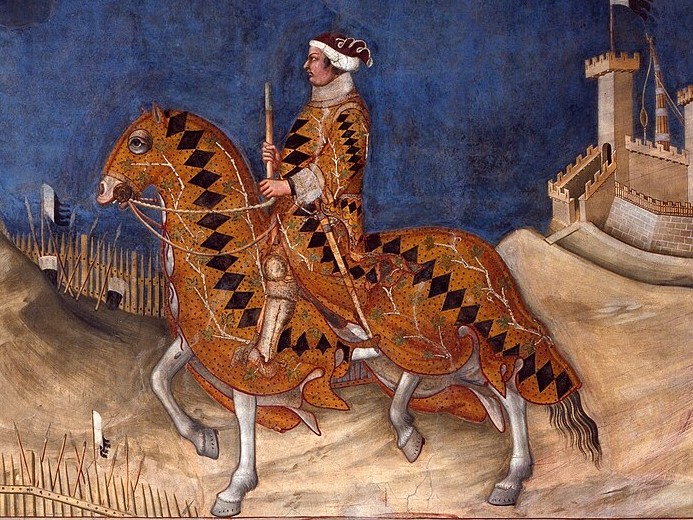
Cover image: Simone Martini (attributed), Guidoriccio da Fogliano at the Siege of Montemassi, 1328 (detail). Palazzo Pubblico, Siena. Public domain.